

Introduction
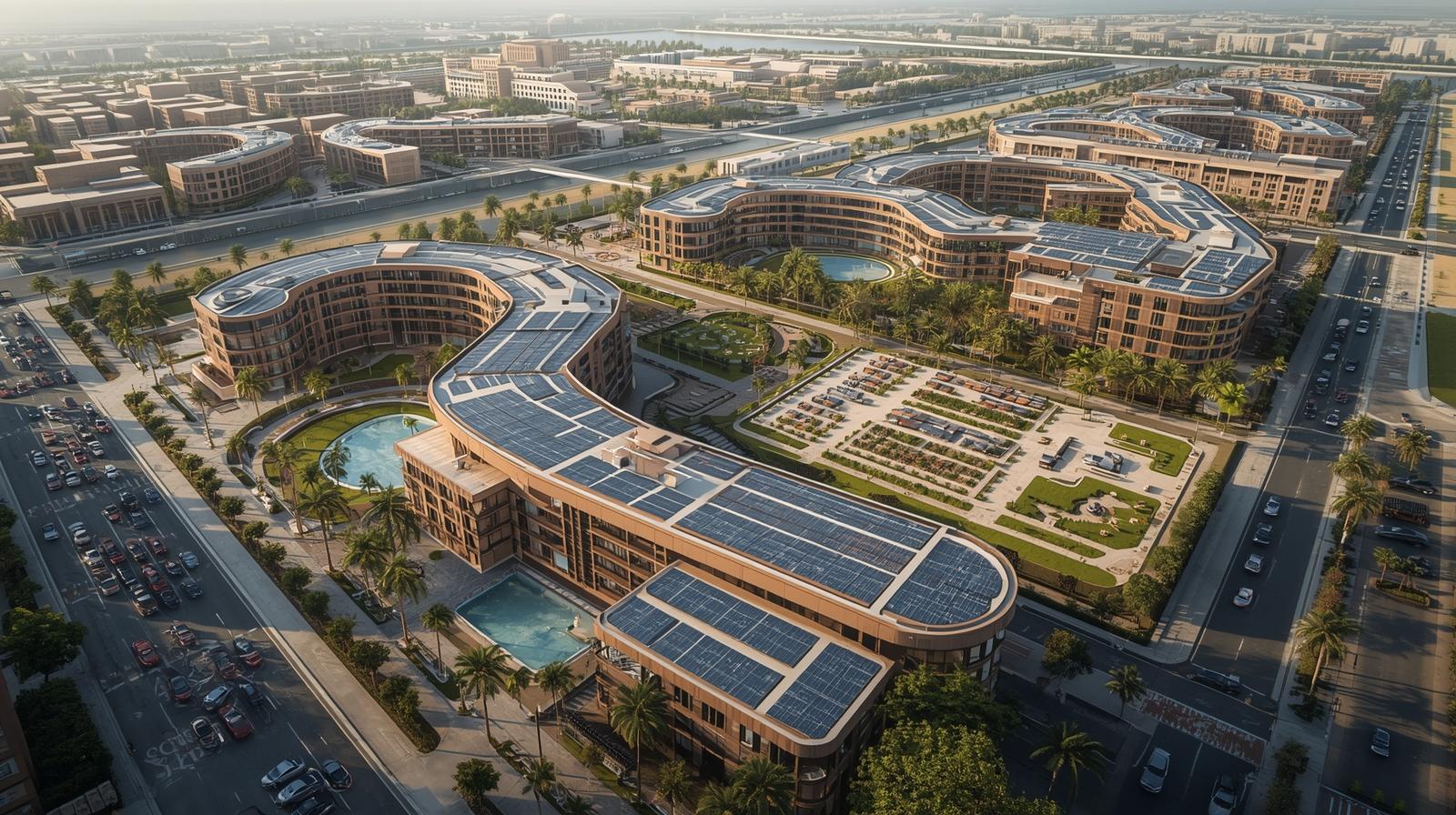
Rising from the desert on the outskirts of Abu Dhabi, Masdar City is one of the world’s most ambitious and closely watched urban experiments. Conceived as a “greenprint” for the cities of the future, it is a living laboratory designed to achieve the highest levels of sustainability and minimal environmental impact. More than just a collection of energy-efficient buildings, Masdar City is a holistic attempt to reimagine urban life itself, integrating renewable energy, water conservation, waste reduction, and pedestrian-friendly design into a single, functioning community. Its successes and challenges offer invaluable lessons for a world grappling with climate change and rapid urbanization.
A Car-Free, Pedestrian-First Community
One of Masdar City’s most radical features is its design as a pedestrian-first environment. The city is raised on a podium, separating the pedestrian level from the street, and is laid out in a compact, traditional Arabic medina-style plan with narrow, shaded streets. This design encourages walking and creates a vibrant, human-scale public realm. To facilitate mobility over longer distances without private cars, the city features a network of electric, automated Personal Rapid Transit (PRT) pods. These driverless vehicles navigate underground, ensuring the streets above remain safe and quiet for pedestrians and cyclists. This commitment to reducing reliance on fossil-fuel-powered cars is a cornerstone of its plan to become one of the world’s most sustainable urban developments.
Harnessing the Desert Sun: A Power-Positive Goal
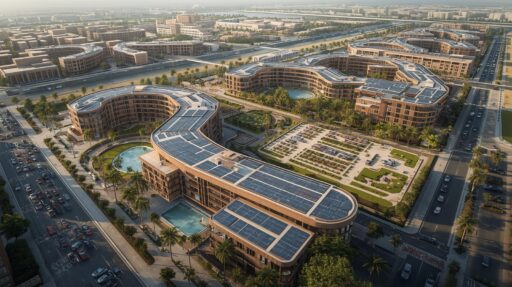
Located in one of the sunniest regions on Earth, Masdar City’s primary energy source is solar power. A 10-megawatt solar farm within the city’s boundaries provides the bulk of its electricity, while rooftop photovoltaic panels on many buildings contribute to a distributed energy network. The city’s orientation and the shading provided by its buildings are also carefully calculated to minimize cooling needs. The ultimate goal is for Masdar City to be “power-positive,” generating more renewable energy than it consumes. This ambition drives continuous innovation in solar technology and smart grid management, making the city a testbed for renewable energy solutions that can be scaled globally.
The Modern Wind Tower: Reviving Ancient Cooling Techniques
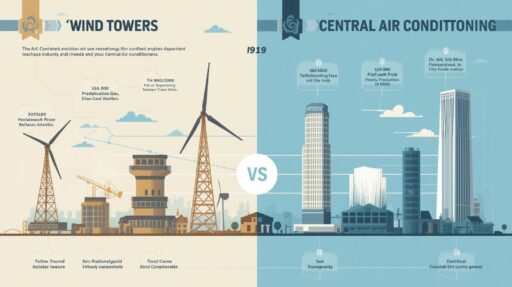
In a brilliant fusion of tradition and technology, Masdar City’s central plaza is dominated by a modern, 45-meter-high wind tower. This structure is a high-tech reinterpretation of the traditional Barjeel. It captures cooler breezes from above and funnels them down into the plaza, reducing the ambient temperature by up to 10-15 degrees Celsius. Surrounding buildings are designed to create a “solar chimney” effect, drawing warm air up and out of the streets. This passive cooling system, combined with highly efficient building insulation and low-energy cooling systems, dramatically reduces the city’s dependence on energy-intensive air conditioning, demonstrating how ancient desert architecture holds the key to modern sustainability.
Water, Waste, and a Circular Economy
Masdar City tackles resource scarcity with a closed-loop philosophy. Water consumption is reduced by 54% compared to conventional developments through the use of low-flow fixtures and water-efficient landscaping featuring native, drought-tolerant plants. A solar-powered desalination plant provides clean water. The city also aims for zero waste to landfill, with an advanced waste management system that sorts, recycles, and converts waste into energy. This commitment to a circular economy, where waste is minimized and resources are continually reused, is a critical component of its long-term environmental strategy.
Conclusion: A Living Laboratory for the World
Masdar City is more than a futuristic project; it is a vital and ongoing experiment. It has already proven that high-quality urban life is possible with a fraction of the ecological footprint of a conventional city. The technologies and design principles pioneered here—from its passive cooling strategies to its smart grid—are being adopted and adapted elsewhere in the UAE and around the world. While the full vision of the city is still unfolding, its core achievement is undeniable: it has shifted the conversation about sustainable urban development from theory to practice. Masdar City stands as a bold statement that the future of cities need not be a burden on the planet, but can be a model of resilience, innovation, and harmonious living.