

Introduction
The Louvre Abu Dhabi is not merely an art museum; it is a philosophical manifesto in architectural form. Rising from the sea on Saadiyat Island, it challenges the very notion of what a museum can be. Conceived by Pritzker Prize-winning architect Jean Nouvel, the museum’s design tells a story of universal human connection, translating the core concept of its collection—the shared history of humanity—into a breathtaking physical experience. Its most iconic feature, a vast, floating dome, is more than a roof; it is the central character in a narrative about light, shadow, and the interconnectedness of civilizations, making the building itself the museum’s first and most profound masterpiece.
The “Rain of Light”: The Magic of the Domed Roof
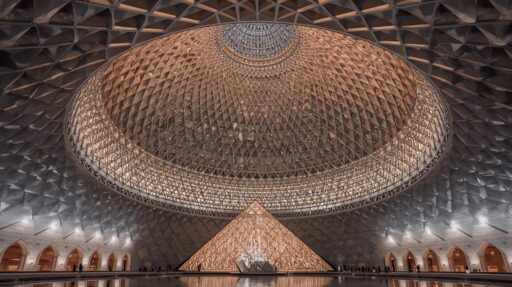
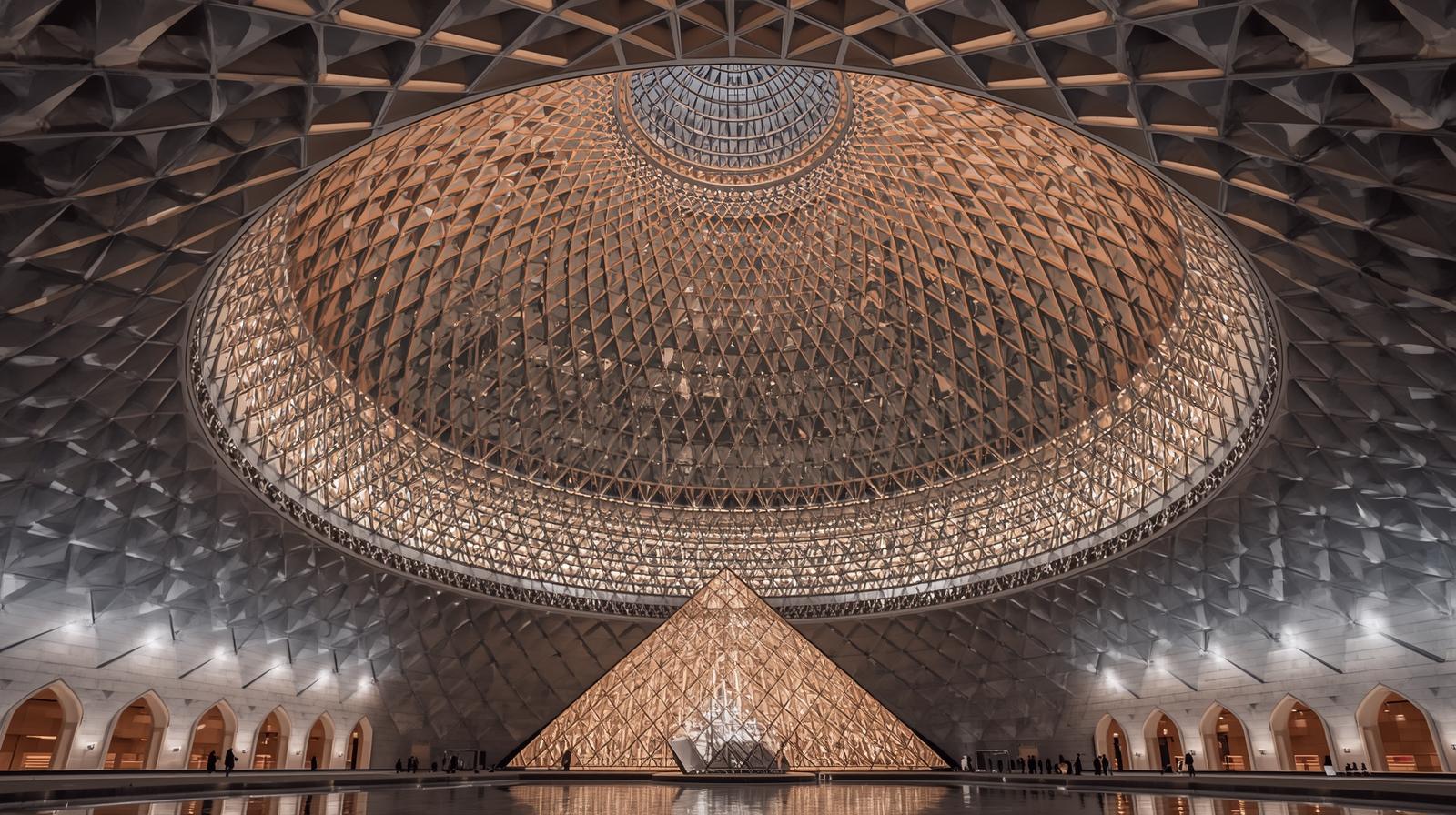
The soul of the Louvre Abu Dhabi is its 180-meter-wide dome. Weighing 7,500 tons—roughly the same as the Eiffel Tower—it appears to float serenely above the museum’s 55 white cubic buildings. The dome is a complex, multi-layered structure composed of eight superimposed layers of steel and aluminum, punctuated by a geometric pattern of 7,850 stars. This design is inspired by the interlaced palm leaves used as roofing in traditional Emirati Arish houses. As sunlight filters through these layers, it creates a mesmerizing effect known as the “rain of light.” The interior is dappled with ever-shifting patterns of illumination, evoking the feeling of walking through a sun-dappled oasis or beneath the shade of a vast palm grove. This celestial canopy connects the interior to the cycles of the day and the sky above, unifying art, architecture, and nature.
A Museum-Village: The Human-Scale Galleries
Beneath the universal dome, the museum is designed as a “museum-city” or “medina,” with 23 permanent galleries housed in a cluster of low-rise, white cubic buildings. This layout is a deliberate departure from the monolithic museum block. It encourages visitors to wander through open plazas and along waterfront promenades as they move from one gallery to the next, mimicking the experience of exploring a traditional Arab city. The human scale of the buildings prevents the collection from feeling overwhelming and creates intimate, contemplative spaces for viewing art. The use of water channels throughout the complex reflects the region’s historical relationship with the sea and enhances the cooling microclimate.
A Narrative of Connection: The Architectural Journey
The visitor’s journey through the Louvre Abu Dhabi is carefully choreographed to reinforce its universal theme. The path through the permanent galleries is chronological, but it is deliberately non-linear. It encourages cross-cultural comparisons, placing a Virgin Mary icon from the Byzantine Empire near a Buddhist sculpture and an ancient Quran. The architecture supports this narrative. The galleries are interconnected, and vistas are carefully framed to create visual links between different cultures and eras. The message is clear: human civilizations have not developed in isolation but have always been in dialogue, influencing and enriching one another. The building itself becomes a bridge across time and geography.
Context and Dialogue: Rooting a Global Museum in the Gulf
Jean Nouvel’s design is deeply respectful of its local context. The white buildings and the dome’s geometric pattern are drawn from Islamic and Arabian architectural traditions. The extensive use of water is a classic element of Islamic gardens, symbolizing life and purity. Yet, the museum is unmistakably contemporary. This synthesis creates a powerful dialogue between the local and the global, mirroring the mission of the museum’s collection. The Louvre Abu Dhabi does not feel like a transplanted European institution; it is a confident, new creation that speaks with its own voice, using the architectural language of the Gulf to frame a story that belongs to all of humanity.
Conclusion: An Architectural Icon for a New Cultural Era
The Louvre Abu Dhabi is a landmark achievement that redefines the role of the museum in the 21st century. It demonstrates that architecture can be a powerful storytelling medium, capable of conveying complex ideas about history, culture, and our shared humanity. Its iconic dome is more than a stunning visual; it is a symbol of shelter—a universal village under one roof where the artistic achievements of all cultures are celebrated together. In its fusion of light, shadow, water, and stone, the Louvre Abu Dhabi offers a hopeful vision: a place where the boundaries between East and West, past and present, dissolve under a canopy of stars, reminding us that art is the common heritage of humankind.